Preparation is Key
My job has now shifted from taking photos to working in a camera shop, where I help both professionals and amateurs. Being honest, the ratio of people I enjoy helping more would definitely sway in favour of the amateurs or hobbyists. A big reason for this is the sheer lack of preparation I hear supposed “professionals” have. It is absolutely wild to me the number of people who phone me up on the way to a shoot who have forgotten a crucial piece of equipment.
I have been on many a shoot in my life. Small ones that took a couple of hours, full-day ones, even weekend-long shoots where I was camping at the festival with limited electricity access. I can honestly say the most I have ever forgotten is a strap or a bongo tie that I thought I had but didn’t need. I am now getting numerous calls every day from “photographers” who, and I quote “, I need a battery for my camera. I’ve got on a train to a shoot and left mine at home. Oh, and can you pre-charge it for me before I come to your store and collect it?”
How on earth do you forget your battery? Why do you only have one battery? What were you doing that was so important that you forgot to check the night before? Now I am well aware I have high-functioning anxiety and also ADHD, so making sure I am organised is both a struggle but also an absolute must, otherwise I won’t sleep. The idea of not being prepared, even when hearing it down the phone, absolutely baffles me to the point I can no longer hold back my sheer level of resentment. To me, bringing all the equipment ready to go and being early, not on time but early, to every shoot is the absolute bare minimum a photographer should be.
So enough complaining about the state of photography these days, like some bitter old man, let’s go through a few tips that helped me stay organised for every shoot I ever went on.
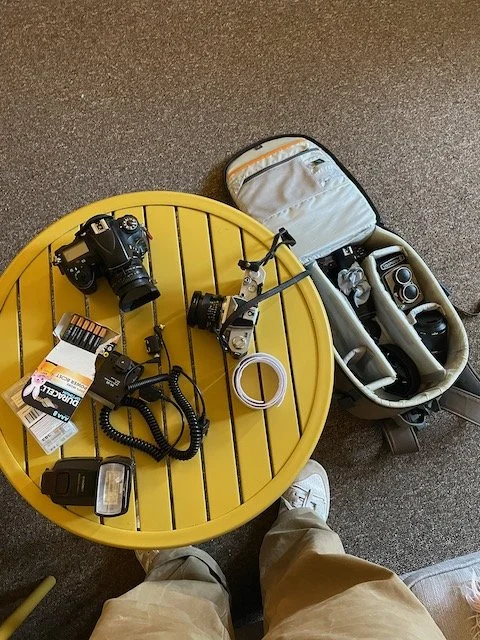
All of my kit laid out fills me with fear.
Firstly, keep your kit ready to go. I’m talking all together near the bag, you know it all goes in lenses, cameras, batteries, all things ready, so when you pack up in the morning, everything you need is right in front of you. It’s an easy thing to get in the habit of doing, and once you do, your life will become so much easier. This also goes hand in hand with having a space in your house or flat or even bedroom, where you can have all your frequently used items near the bag you always use, despite having over 1000 of them like me. I use my desk, which also acts as my editing space. I keep the things I know don’t need servicing, cleaning, or charging in the bag and just double-check the hoods aren’t broken and the elements are clean when I’m on set.
Next, I recommend keeping things that go together…. together? I know this really must be advice from an oracle from a different land. You would be amazed at how many little things and bits you will acquire when working as a photographer. I’m not talking about lens caps or body caps. I mean PC Sync cords, flash gels and diffusers, backup memory cards. I have clear bags from Panavision (they are lovely and colour-coded), and each one will have things like fixtures to hold up backdrops, or accessories for my flash guns.
Now, a big one, cleaning and maintaining your equipment. This doesn’t have to be a CLA after every shoot or a full sensor/mirror box service, by the way, as you would definitely see a huge drop in your profit for each shoot. I’m talking when you have 30 mins as your files are exporting. Take your items out and check that they are all working. Clean your lenses, check your batteries are charged if you shoot film, check you have enough rolls for the next couple of shoots and check your film cameras are all cleaned and firing correctly. It’s little things like this that will really allow you to keep track of what you have and how ready it is.
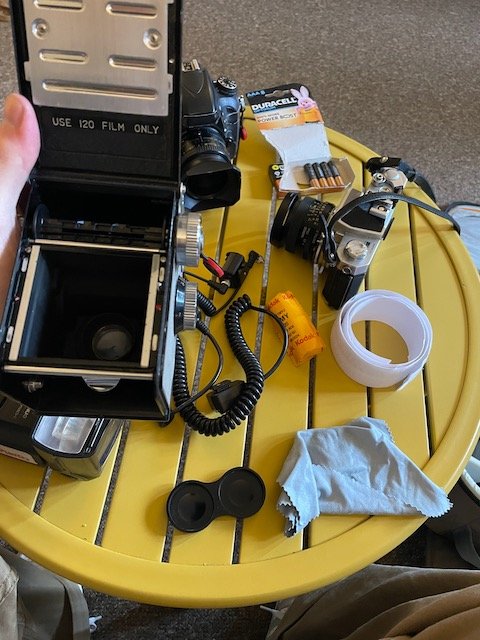
Cleaning a TLR should be easy but I always find it fiddly
Lastly, and I think probably the most important. Keep your gear simple. This is not an attempt to tell you gear doesn’t matter or that you have been tricked by the camera illuminati to buy every latest model. What I mean is every lens or camera or accessory you buy should work with your current kit and fill a gap. Doubling up on focal lengths or buying that new strap/bag, better replace one as otherwise you just have another thing to forget. For years now, I have aimed to keep my kit as slimmed down as possible, running a max of 3 lenses which span 2 cameras ( one 35mm film and one digital), and then I will have my 120 film camera, which has a lens built in (TLRs rule). Even keeping my kit as small as possible, I still find myself needing to take stock of everything I have and make sure I am not overpacking for each job.
I hope these tips have helped, and obviously, if you do phone me up needing a vital piece of gear, I will do everything I can to help; however, I can not make any promises. Happy shooting and please try to be more organised than me.
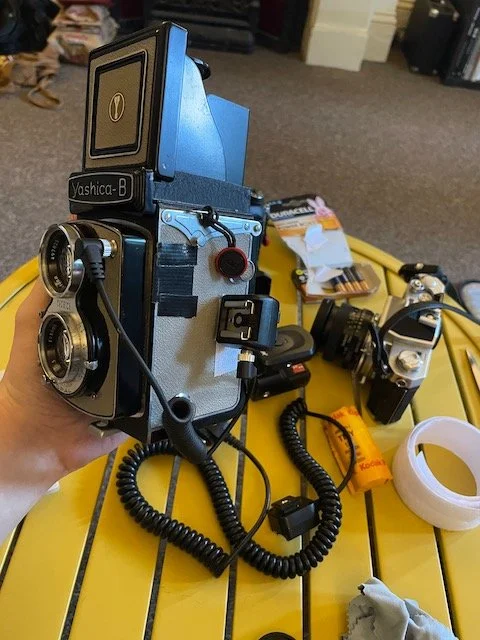
My home-fangled way to connect my wireless flash system to my TLR.